
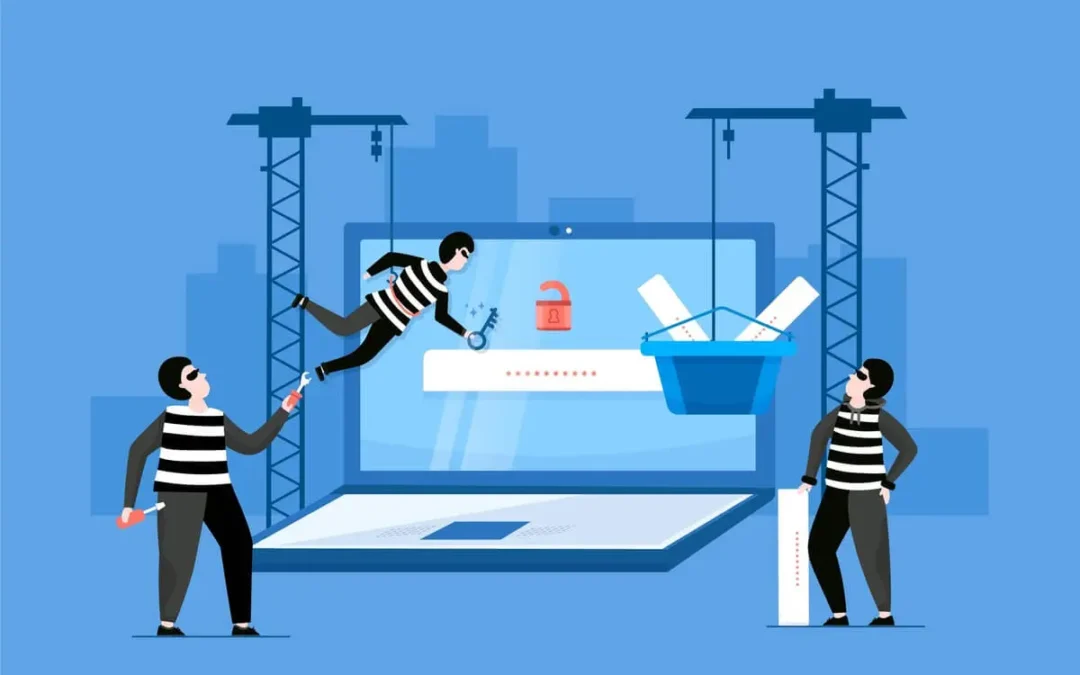
Credential phishing is the type of attack attempting to steal information that is associated with sensitive login credentials, usernames, passwords, or any other information used for authentication. The people don’t know they are being cheated and offer the login information while trying to get access to real sites; sometimes, their sites resemble the original ones. The stolen credentials give the cybercriminal unauthorized access to individuals’ accounts, companies’ systems, or confidential data.
These services may include email, internet banking, social media, or company systems. Being by the nature of internet integration, credential phishing is always one of the methods hackers frequently use against individuals and organizations.
How Does Credential Phishing Work?
Credential phishing is a process with more than one step, so it must fool the victims into giving away their sensitive information at every turn. Every phase is both designed and aimed to deliver a sense of urgency and a sense of legitimacy at each stage, so the chance of a victim falling for the scam increases at every step.
1. Baiting with a Phishing Email or Message:
The first step of a credential phishing attack is sending a well-dressed message to the target. It might be an email, SMS, or social media communication that shall claim to come from some reputed company, financial institute, or even a friend. Then the attacker would spoof the “from” address or display name to make the message appear legitimate.
For example:
- Your account is compromised! Reset password at once.
- Unusual login detected. Confirm your account details now.
The attackers are relying on panic, hoping that the person being harassed will click on the link without verifying whether the message is genuine.
2. Redirected to a Fake Website:
Then, after the activation of the link given, the victim is taken to a counterfeit website appearing to resemble the real one as a login page of a bank, a portal site of an email service provider or an e-commerce site. In general, such sites are made with great care for detail. There may be close copies of the logos, fonts, and even layouts of the real sites. Even the URL could almost be correct-except for some minute detail, such as an “i” substituted for a lowercase “L” or an added letter to the domain name (“banksecure.com” instead of “bank.com”). This phishing site is the heart of the operation, as that is where the attackers are hoping the victim would feel comfortable enough to enter their login credentials. Users may not notice anything inappropriate, especially if the site looks professional, thus increasing the probability of success.
3. Collecting Credentials:
Upon being taken to the phishing site, the victim is asked for his or her login credentials, such as username and password, in fields that mimic the site of authenticity. Often the phishing site may solicit even more information by providing a series of “security” or “verification” steps, some of which include:
- Responses to security questions.
- Two-factor authentication codes.
- Credit card information.
- Personal identification numbers (PINs).
- Social Security numbers and other identifying information.
The moment the victim shares this information, it is sent directly to the attacker. The phishing website can forward the victim to the real website once it has taken the data, which the victim may then think nothing has gone wrong.
4. Leveraging the Stolen Information:
Once the trespasser gets the credentials of a victim, he can access the account directly by obtaining the information for immediate use.
- Bank or other payment service accounts: This is where the attackers will have unauthorized transactions made, thus siphoning off the money in that account or stealing the whole account over.
- Email or social media accounts: The attackers can send phishing emails or messages to contacts from the victim’s email or social media accounts or to try to reset the passwords of other services linked to the affected account.
- Corporate Systems: Phishing through credentials can severely breach the security of most businesses as an attacker can gain access to sensitive company data and intellectual property or even privilege accounts with administrative access to critical systems.
The attackers may do nothing at all, immediately. These leaked credentials can be saved for later use or sold on the dark web. In other instances, attackers even utilize the stolen credentials as part of a larger scheme-for instance, as part of ransomware or corporate espionage attacks.
5. Advanced Credential Phishing Methods:
Attacker also sometimes involves more sophisticated techniques to carry out these crimes:
- Man-in-the-Middle (MitM) Attacks: MitM basically tracks the communication between the user and a legitimate website. This allows the attacker to capture live credentials.
- Credential Stuffing: If attackers find credentials from one source, then they might attempt using the same username-password combinations across other platforms for the assumption that many users reuse their login details.
The Dangers of Credential Phishing
Credential phishing poses several risks-serious both in terms of individual and organizational interests:
- Data breaches: The login credentials will enable attackers to break into the system and obtain private information ranging from personal info to financial records and intellectual property. Such attacks would be a heavy blow to businesses in terms of losses; loss in terms of dollars through data breaches, customers’ distrust, and liability.
- Financial Loss: Hackers will then use those stolen credentials to make unauthorized transactions or siphon funds from their accounts in a bank, make fraudulent purchases, etc. An individual will suffer direct financial loss, and a firm will face great monetary loss through fraud or ransom demands.
- Identity fraud: Normally, the identity thief can thereafter use the information to pose as the victim either by opening new accounts in his name or applying for loans and committing other identity frauds once he gains access to the personal information. This may all result in immense loss in the long run to the credit rating and personal reputation of the victim.
- Corporate Espionage: Often, credential phishing is just a step of a more complex effort to invade the internal systems of an organization. For example, criminals may obtain classified business information or even monitor the operations of the targeted organization that would lead to disadvantages and major financial hurts in terms of competition.
- Further Exploitation with Privileged Access Further, if the attackers are able to acquire the organization’s credentials that contains administrative or privileged access, it would help these attackers elevate their attack completely to take over control of the entire network. This helps an attacker disable all sorts of security controls, install malware, or manipulate system configurations in order to prolong their access and have a bigger impact.
Protecting Against Credential Phishing
Therefore, both individual and organization will have the necessitated key security practices to reduce the risks of credential phishing.
- Multi-Factor Authentication: In such a case if somebody does steal your credentials, requiring another layer or two of additional security can thwart unauthorized entry.
- Spam filtering and security software: It can filter to block spam emails and flag suspicious sites with the assistance of security software.
- Be Careful When Validating URLs: Make sure a site is authentic by checking, rechecking authenticity before entering your login information as well as when being prompted by unsolicited messages.
Credential phishing is one of the huge issues in this modern world that one finds very hard to ignore, mainly because most systems update information about phishing rates. If one is also briefed on how it is actually carried out, the chance to fall prey to it is significantly reduced.
Don’t Get Hooked! Unmasking the Dangers of Credential Phishing
Protect your logins from sneaky scams. Learn how credential phishing works and how to stay safe online.Got time? Explore more!
API-First Development:Building Scalable Backend Systems for Growing Startups
Growth is the name of the game in today’s rapidly changing digital economy, and startups need applications that grow, are flexible, and are scalable. These days, businesses are not confined to a single web application. Rather, they are responsible for managing mobile apps, web platforms, third-party integrations, cloud services and customer-facing APIs all at once. Typical backend development approaches are less effective in this scenario. That’s why API-first development has emerged as a successful strategy for startups to scale. API-first development is the practice of designing APIs before designing software. APIs are no longer add-ons, they are the backbone of the system architecture. This allows independent front end and back end work, while keeping everyone in the loop. APIs will become a major focus of startup development at the outset, thereby facilitating easier scalability, maintenance, and integration with future technologies. API-first architecture also enhances the development process by facilitating faster building times and helping to ensure that the businesses provide optimal user experience.

Understanding API-First Development:
API-first development is about designing the communication pattern first, and then writing the application. APIs are like contracts . They define how data and functions are shared between different systems . This helps to normalize all services, applications and integrations. Common application development models involve building backend systems first and then adding APIs later on as needed by the front-end applications. This can result in endpoint inconsistencies, documentation issues and problems with scalability. API-first development avoids these issues by designing the API from the beginning of the project. This is particularly helpful for startups, since a number of teams can work concurrently. Frontend developers can create interfaces with a mock API and backend engineers can create the actual services. The parallel workflow allows to shorten the development time and enhance team productivity.
Benefits of API-First Architecture:
One of the greatest benefits of API-first architecture is scalability. When startups expand, their applications will most frequently spread to a number of platforms including Android App, iOS App, Website, Smart Devices and Cloud Services. APIs are a standard communication layer that enable all these platforms to communicate with the same backend system. One of the other key advantages is flexibility. API-first systems simplify the process of connecting with third-party services like payment gateways, CRM platforms, analytics, and authentication providers. The new technologies are easy to integrate and don’t require rebuilding the back-end infrastructure of the business. API-first development also lets teams work better together. The API contracts describe how the system works so different team members can work on it without getting in each other’s way, such as designers, front end developers, back end engineers and QA testers. It avoids confusion and delays in development. Also, consistent APIs lead to consistency across apps. The structured data and user experience is the same whether accessed through the mobile app or web browser.
RESTful API Best Practices:
REST is still one of the most popular ways to build APIs because it is simple and scalable . There are some basic rules for RESTful APIs to enable efficient communication between systems. One of the important best practices is to have clear and meaningful names of resources. Endpoints should be a logical resource (for example /users, /products, /orders) It is easier to read the code and for developers to do the integration if the same name is used. Moreover, REST APIs should follow the correct usage of HTTP methods. GET method is used to fetch data , POST method is used to create new resources , PUT method is used to update the existing resources , DELETE method is used to delete resources . Following these standards can help ensure the API behaves consistently. One important practice is to return consistent json responses with the correct status. APIs should provide a clear, concise error message and a consistent response to facilitate problem identification. Also, if the data set is large, be sure to paginate it for performance and to keep server load down.
GraphQL and Modern API Development:
For applications that need flexible data retrieval, GraphQL has become a strong alternative to REST API, particularly in that regard. In contrast to REST, which has many endpoints, GraphQL has one endpoint into which clients “query” just the data they need. This way you’ll minimize over and under fetching of data. A mobile app, for instance, might only ask for certain product data rather than unwanted information. This boosts performance and consumes less bandwidth. The major advantage of GraphQL for the front-end dev is the increased control it allows him/her to have over the queries for the data. he flexible nature of GraphQL may prove beneficial for complex interface-based applications. However, there are several issues related to GraphQL. The technology might complicate caching, querying, and security aspects. If the data structure that users are requesting is deeply nested, the poorly designed GraphQL system can lead to performance problems. REST APIs are the better solution for many startups, and GraphQL the better solution when applications get more complex.
API Versioning Strategies:
APIs need to be updated once startups grow and new features and business demands are added. Any change may lead to the failure of old software if versioning is not used in case there are any modifications to the API because of its versioning, developers can implement their changes and remain compatible with older versions. URL versioning is one of the widely used techniques whereby a particular version is attached in the URL itself like “/api/v1/users” or “/api/v2/users”. This method can be understood easily. The other technique of API versioning is by including versions in the request headers. Adopting effective versioning strategies makes it easier to manage growth without causing hassles for users. They should also not make unessential breaking changes, and give developers time to upgrade to the newer versions of their API.
Documentation with OpenAPI and Swagger:
Documentation is key to a successful API-first development. Without good documentation, onboarding is slow, integration is prone to mistakes and there is confusion between development teams. OAS has become the industry standard for API documentation of REST APIs. It specifies endpoints, request parameters, the structure of the response, the authentication process, and what constitutes an error. Swagger is used for the generation of automatic interactive API documentation. Tests on the API endpoints can be done using the API documentation user interface itself, resulting in an effective integration process. The documentation proves useful for third-party software developers or business partners interested in integrating external software to your startup platform.
Authentication and API Security:
Another part of the development of backend systems that needs special attention is security. Many APIs work with confidential data that can be user details, financial information, credentials, and so on, which makes them very attractive to hackers and attackers. Among the most popular methods of implementing security for your application, you may try Token-based Authentication using JSON Web Tokens. After logging in to an application, the user receives a token with which he will later make requests to the API. Another solution, which is widely used in 3rd-party authentication, is OAuth 2.0. This solution allows your users to log in to your application using other websites like Google and Facebook without providing you with any passwords. Also, all communication between an API and a client should use HTTPS encryption.
Rate Limiting and Performance Management:
The backend systems will have to deal with problems related to managing increased traffic owing to increased numbers of users for the start-ups. The APIs may be abused, spammed and even subject to DoS attacks. Rate limiting involves restricting the number of requests that each user can submit within certain periods. For example, one API may allow 100 API calls within one minute for any one user. This measure reduces overloading of the system thus improving its stability. There are other ways such as caching to improve performance. API gateways and cloud platforms may come with native monitoring and performance optimization features that assist small businesses grow efficiently. Startups with plans to accommodate high user and third-party integration counts will be particularly interested in performance management.
Transitioning from Monoliths to Microservices:
Most startups develop their applications in monolithic fashion as it is easier to build and deploy them in the initial stage of their operations. But larger systems can present scalability and maintenance issues in monolithic systems. API-first architecture makes it easier to switch to microservices. In the microservices approach, there are small services dealing with various aspects of the business, including payments, authentication, inventory, and notifications. The services exchange the information via API. Each microservice can scale independently, which enhances deployment flexibility and fault isolation. Development teams can modify a single service without impacting the overall service. But, do not rush the transition to microservices as it adds complexity to the operations of the startups. It is best to phase in a gradual approach.
Conclusion:
The practice of API-first design has been established as a valuable approach in building scalable and future-ready backend solutions by startups. By focusing on building an API rather than implementing something, a startup can benefit through better collaboration, faster frontend development processes, and third party integration. There are multiple practices that help establish an ecosystem of APIs including principles behind RESTful design, GraphQL’s flexibility, documentation, authentication, rate limiting, and testing approaches. API-first design also helps a company progress further into microservice architecture as the business evolves. In the ever-growing digital world, it is clear that investments into powerful API architectures will help startups scale effectively, deliver smooth user experiences, and stay resilient.
Leveraging Predictive Analytics:Turning Customer Data Into Revenue Growth
Digital analytics dashboard displaying charts, graphs, and performance metrics on a computer screen, representing business intelligence, predictive analytics, and data-driven decision-making.

AR Product Visualization in Mobile Apps: The Future of Online Shopping
Explore how AR product visualization is transforming e-commerce UX with immersive mobile shopping experiences, virtual try-ons, and interactive product previews.


