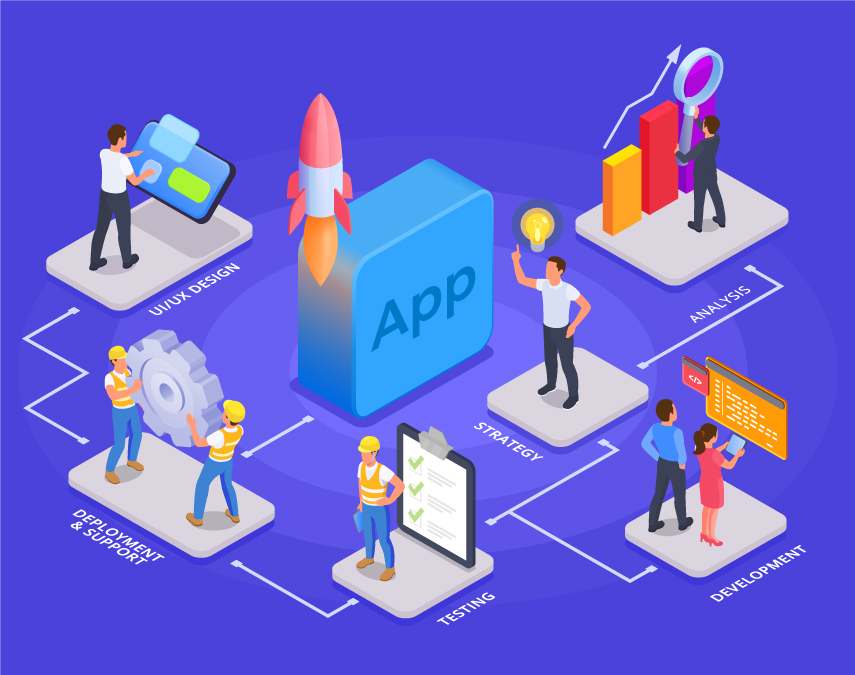
The mobile application market is in a state of unprecedented development that has been propelled by high-technological change and increased demands of users. By 2026, mobile applications cease to be mere tools, but they are smart platforms that drive digital experiences, business processes, and customer experiences. The trends that define the future of mobile app development should be grasped by the companies that intend to remain competitive and change their strategies in line with them. The article examines the five most popular trends in mobile app development that are destined to affect the way apps are developed, deployed, and experienced in 2026 and the reasons why they will be important to both businesses and developers.
AI-Powered Mobile Apps Become the New Standard:
AI is never bedded in as a value added feature in mobile app anymore it is developing into a standard feature. Integration of AI in 2026 will be at the center of provision of smarter, personalized and more efficient user experiences. Mobile applications are gaining more and more possibilities in recognizing user behavior, anticipating their preferences, and real-time content customization. Personalization through AI enables apps to offer suggestions, alerts and user interfaces depending on personal usage. As examples, e-commerce apps can be more accurate in suggesting goods, whereas fitness and health apps can offer more tailored advice based on the data provided by the user. In addition to personalization, AI can improve voice recognition, image processing, chatbots, and predictive analytics, making the apps more interactive and intuitive. In terms of development, AI is also the best to streamline the backend operations through automation of data analysis, enhanced performance monitoring, and anomaly detection prior to impacting users. With the increased availability of AI frameworks, even small and midsized businesses would be able to create smart mobile apps that can compete with those at the enterprise level.
Cross-Platform Development Gains Greater Maturity:
In 2026, cross-platform frameworks become even more popular, and at the same time, they become more mature and reliable. Flutter, React Native, and Kotlin Multiplatform are the technologies that allow developers to create high-performance apps with a single codebase that has almost-native user experiences. The main strength of a cross-platform development is efficiency. Companies are able to significantly cut down the development time and expenses and at the same time reach users on both iOS and Android. These frameworks provide better rendering engines, better hardware integration, and better support of platform-specific features in 2026. To the users, the advantage is consistency. The apps are similar to the behavior and experience of different devices, which brings a cohesive brand positioning. To businesses, a faster release cycle implies a faster entry into the market and more frequent release. This will be the method of choice when starting off or in an existing business as frameworks continue to bridge the divide between native and cross-platform performances.
Enhanced Mobile App Security Takes Center Stage:
As digital services increase the security risk increases. Mobile app security will be prioritized in 2026 as cyber-attacks will be more complex, and data privacy laws will become more stringent. The users are more conscious of the way their information is processed, and any violation may have disastrous reputational and financial consequences. New mobile applications are adopting superior security controls including biometric authentication, end-to-end encryption, secure API and AI-based threat detection. Real time identification of suspicious activity is also being accomplished through behavioral analytics so that apps can take precautionary action against potential attacks. Considering the aspect of development, security is becoming left shifted in the development lifecycle. Not only are secure coding, automated vulnerability scanning, and compliance checks now part of CI/CD pipelines but are also linked to them. Security is no longer an issue that is implemented after deployment but rather a design consideration. Firms that are keen on the security of their mobile applications will gain the confidence of their users and gain sustainability in the long run.
5G and Edge Computing Unlock New Performance Levels:
The 5G networks that have been adopted widely are changing the capabilities of mobile applications. The data speeds will be faster, latency will be lower and network reliability will be enhanced in 2026, enabling developers to create more rich and responsive applications. This is especially effective on apps that need real-time interactions like gaming, streaming, augmented reality and IoT-based services. Edge computing also increases performance by enabling data processing near the user instead of it being centralized on cloud servers alone. This saves time wastage and enhances responsiveness particularly on applications that need real time response. As an example, a route can be updated immediately with the help of navigation applications, and smart health applications can process data in real time. In the case of business, such a combination provides chances to provide advanced features otherwise impossible on mobile devices. The developers are now required to develop apps exploiting 5G possibilities and remain efficient to users in areas with lower connectivity.
Immersive Experiences Through AR and Advanced UI/UX:
The expectations of users to mobile apps have never been high. Immersive technologies like augmented reality (AR) will cease to be a novelty and become a tool to use in industries in 2026. Retail applications make use of AR to enable customers to see products in their surroundings whereas education and training applications develop interactions in learning. Meanwhile, UI/UX design is undergoing changes as a means to accommodate such immersive interactions. Gesture interface, motion feedback, and intelligent layouts are on the rise. Apps are created in a way that is more natural and intuitive and less consumes cognitive load and more engages users. Accessibility is also a key factor in the current trends in UI/UX. When apps are designed inclusively, it means that individuals with a variety of abilities can use them, meaning that accessibility is not only a compliance measure but a competitive edge. The future of mobile apps will be seen in the visual, emotionally responsive and universally accessible experiences.
Why These Trends Matter for Businesses:
These trends of mobile app development are not only technical innovations, but they have a straight face to business success. With AI-driven personalization, there is increased engagement and retention. Cross-platform development saves time-to-market and cost. Safety on a higher-level safeguards brand identity and consumer confidence. 5G and edge computing make it possible to offer innovative services, and immersive design makes users more loyal. Firms, which match their mobile strategy with these trends, are in a position to respond to such demands in the future and outcome with other firms. Instead, they should be ignored at the risk of being left behind in a market where the expectations of users keep changing at a very fast pace.
Conclusion: Preparing for the Mobile Future in 2026
The intelligence, speed, security, and immersive user experiences are the characteristics of the mobile app landscape in 2026. New technologies are transforming the methods of creation of apps and interaction between them and users. On the side of the developers, this entails adoption of new tools and frameworks. In the case of businesses, it translates into investing in mobile solutions that are future-ready, scalable as the business grows and becomes innovative.
These five best trends in the mobile application development are the ones that by comprehending and embracing them, organizations are able to create applications that are not only effective, but progressive. The apps that will be successful in 2026 are those that will be made with flexibility, user confidence and technological perfection.
Beyond the Screen: Leading Mobile Development Trends for 2026
Stay ahead of the curve with the top 5 mobile app development trends for 2026. From AI-driven personalization and cross-platform maturity to the transformative power of 5G and immersive AR experiences, discover how these innovations are redefining digital engagement and business success.
Got time? Explore more!

Building Accessible Mobile Apps WCAG 2.2 Compliance in Flutter and React Native
Developer implementing WCAG 2.2 accessibility features in Flutter and React Native mobile applications for inclusive user experience.

AI-Powered Code Review: How DevOps Teams Are Achieving 40% Faster Release Cycles
DevOps team collaboration with development and operations integration for faster software release cycles
The Complete Guide to Conversion Rate Optimization for Pakistani E-Commerce Businesses
CRO strategy for Pakistani e-commerce website conversions